In my internship at the Center for the History of Medicine I got the chance to process four collections and publish their Finding Aids to make them accessible to researchers. These collections consisted of materials such as photographs, letters, telegrams, diaries, maps, and postcards ranging from 1890 to 1949. This was my first time working in an archives, so it was a great experience getting to see a lot of materials for the first time and figuring out what they were and how they fit into their collection. A lot of the process felt like I was solving a puzzle, except I did not know what it would look like once completed. Through the process of solving these puzzles, as well as the supervision of Rebecca Thayer, I learned a lot about archival principles and why they are used.
The first collection I processed was the Ralph Emerson Wheeler diaries. Ralph Emerson Wheeler was a professor of bacteriology and epidemiology at Tufts University from 1943 to 1966. He also founded the Department of Biological Engineering at Tufts University before retiring in 1971. The diaries describe Wheeler's experiences as a teenager; his time as a student at Harvard Medical School; and his post-Harvard Medical School studies and travels in Germany and France. The diaries also document Wheeler’s participation in a specimen collection expedition in South America for the Museum of Comparative Zoology at Harvard University. For more information on Wheeler and his collection, please view the Ralph Emerson Wheeler diaries online finding aid.
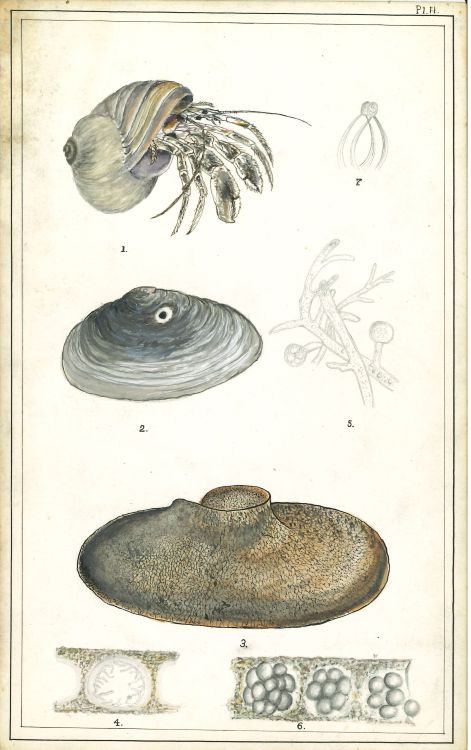
The second collection that I processed, and my personal favorite, was the Albert H. Tuttle papers. Albert H. Tuttle was a surgeon based in Cambridge in the late 19th and early 20th centuries. He designed and operated his own private hospital in 1895 which was also located in Cambridge. The papers contain Albert H. Tuttle’s reports, correspondence, research notes, writings, and photographs. Unrelated to his role as a surgeon he studied ornithology and taxidermy. Within the research notes was a group of anatomical notes and drawings that had originally been assumed to be from his medical studies, but were actually of Lunatia heros (the Northern moon snail, now Euspira heros). These research notes were the most interesting to me as they showed the range of interests held by Tuttle throughout his life. For more information on Tuttle and his collection, please view the Albert H. Tuttle papers online finding aid.
The third collection I processed was the William Aden Powell papers. William Aden Powell served as the head surgeon of the United States Army's 76th Division. During World War I he was stationed in France, Luxembourg, Germany, and the Philippines where he oversaw medical personnel and facilities. The papers consist of diaries and correspondence from Powell's World War I military service and an illustrated biography about the lives of Powell and his wife, Eva, from 1908–1915, created by their daughter Julia. For more information on Powell and his collection, please view the William Aden Powell papers online finding aid.
The final collection I processed was the Barclay G. Jones correspondence about Marian Turski. Barclay G. Jones was a member of the United States Army during World War II who was held at a German prisoner of war camp where Marian Turski, a Polish physician, worked. Turski treated Jones while at this prison camp. The papers consist of Jones' correspondence with and about Turski as he attempted to help Turski legally emigrate to the United States from Poland after the war ended, but Turski instead emigrated to Canada in 1949. Also included are letters between Jones and lawyers and resettlement agencies in the United States. For more information on Jones and his collection, please view the Barclay G. Jones correspondence about Marian Turski online finding aid.
For information about accessing any of the above collections, please consult the Center’s website or contact Public Services.